Wheel loader daily inspection checklist
A wheel loader spends its day moving: forward into the pile, back out, a turn, forward again. So its daily check leans on the parts that take that cycle — the tires, the articulation joint the whole machine bends around, the coupler holding the bucket or forks, and the brakes and steering that stop and point it. The walk below starts at the tires and works round the frame to the front end, then checks the functions with the engine running, then looks at the ground and the people around you.
Your operator’s manual is the authority for anything model-specific: tire pressures, the lube chart, how your coupler locks, which options your loader carries. The table after the checklist sets out what each province and US OSHA asks, rule by rule.
Engine off — the walkaround
- Tires and chains — cuts, chunking, and sidewall damage, pressure to your operator’s manual; in winter, chains tight with no broken links.
- Wheel nuts — every nut there and tight. Rust streaks or bright metal around a nut usually mean it has been moving.
- Articulation joint — pins and bushings greased, no play when the frames move, no cracks around the hinge plates.
- Articulation lock — stowed for work; fitted whenever anyone services the machine or stands between the frames.
- Frame — cracked welds on the loader tower, the rear frame, and the counterweight mounts.
- Coupler and attachment pins — bucket, forks, or pusher seated, locking pins or wedges fully through, indicator showing locked.
- Lift arms and linkage pins — every pin on the lube chart greased, no slop at the bell crank or tilt link, no cracked bosses.
- Cylinders and hoses — rods unscored, hoses not chafed where they cross the frame. Look for leaks; never feel for them.
- Axles and hubs — wet hub seals, oil on the inside of a rim, drips under the axle housings.
- Fluids and fresh drips — engine oil, hydraulic oil, transmission, coolant, fuel, and diesel exhaust fluid where fitted; then look under the machine.
- Steps, glass, mirrors, and cameras — steps and handrails clear and solid, glass uncracked, mirrors and cameras clean and aimed at the back corners.
Engine on — the function checks
- Service and park brakes — the loader stops straight when you brake, and the park brake holds it where you leave it, on a grade if you have one.
- Steering lock to lock — full left and full right without binding, groaning, or delay; the frames answer the wheel.
- Lift and tilt — full travel both ways, smooth, and no drift with the bucket raised and the controls released.
- Ride control and kick-outs — where fitted: ride control switches on and off, and return-to-dig and lift kick-outs stop where they’re set.
- Lights, beacon, alarm, and horn — every one works. A loader spends much of its day backing up.
- Gauges and seat belt — no warning lights left on, hour meter reading noted, belt present and latching.
Around the machine
- Rear blind zone — walk behind the machine before you climb on: the counterweight hides a person standing close.
- People on foot — where they walk, where they stand to talk to you, and that they get your attention before they come close.
- Stockpile faces — faces taller than the bucket reaches, and overhangs that can let go onto the machine; never undercut a face.
- Overhead clearance — power lines, doorways, conveyors, and roof beams, measured against the bucket at full height.
 wearpoint
What the rules ask, jurisdiction by jurisdiction
Do this walkaround before every shift. Where a rule below doesn’t name a daily inspection, it often requires the machine to be inspected or used according to the manufacturer’s instructions — so check what your operator’s manual calls for before each shift.
Each row is what one regulation asks of this machine, in plain words, with a link to the text. Where a rule depends on the kind of site or machine, the row says so: check it against your own. This is a summary, not legal advice — the regulation and your operator’s manual govern.
Alberta
Before operating powered mobile equipment, the operator must complete a visual inspection of the equipment and the surrounding area. OHS Code s.257(1)
British Columbia
Before mobile equipment is first operated on a shift, the operator must inspect it and report any unsafe or potentially unsafe defect to the supervisor or employer, then keep monitoring it while it runs. The employer keeps a record of reported defects for at least 2 years. OHSR 16.3(1)–(3)
Ontario
Construction projects: No vehicle or machine may be used while it is defective or hazardous, and it must be used as its manufacturer’s operating manual says. Powered equipment rated over 10 horsepower must be inspected by a competent worker before it is first used at the project, then at least once a year or more often if the manufacturer recommends. Neither section sets a daily inspection. O. Reg. 213/91 ss.93–94
Every workplace: The employer must keep the equipment it provides in good condition, and a worker must report a known defect that may endanger a worker to the employer or supervisor. OHSA ss.25(1)(b), 28(1)(c)
Quebec
Construction sites: Any self-propelled vehicle or equipment driven by a power source other than manual must be checked by an experienced person before its first use on the site, then daily whenever it is used. CSTC s.3.10.1(b)
Elsewhere, such as a yard or plant: A self-propelled vehicle must be inspected and maintained according to the manufacturer’s instructions or standards offering equivalent safety. Section 272 sets no inspection frequency of its own. RSST s.272
Nova Scotia
The employer must ensure powered mobile equipment and forklifts are operated, inspected, serviced, maintained, and repaired according to the manufacturer’s specifications, or specifications certified by an engineer. N.S. Reg. 44/99 s.55
United States (federal OSHA)
General industry: OSHA’s forklift standard does not apply to vehicles intended primarily for earth moving, and OSHA has said front-end and backhoe loaders stay outside it even with forks fitted. 29 CFR 1910.178(a)(1); OSHA interpretation, 1999-10-21
Construction sites: OSHA’s earthmoving equipment rules set no inspection interval of their own. 29 CFR 1926.602(a)
Construction sites: The employer’s safety program must provide for frequent and regular inspections of equipment by competent persons it designates. Equipment that doesn’t comply with OSHA’s construction rules may not be used and must be tagged, have its controls locked, or be removed. 29 CFR 1926.20(b)(2)–(3)
Not in the table yet: Saskatchewan, Manitoba, New Brunswick, Prince Edward Island and Newfoundland and Labrador. We add a province once its official text has been checked.
Scrap, snow, and site: what each duty cycle wears first
Scrap. In a scrap yard the tires go first. Sharp steel on the yard floor cuts tread and sidewalls, and a sidewall cut is the one that ends a tire. Walk all four, all the way round, every day. Guarding matters too: check the screens on the cab glass and the guards over the lights and the hoses at the front end, because that is where pieces bounce off the bucket. Clean wire and loose scrap out of the articulation area before it wraps round a hose or a driveshaft.
Snow. On snow duty a loader often runs a pusher instead of a bucket, so the coupler pins and the pusher’s mounts get the attention the bucket edge would. Chains get checked with the tires: tensioners in place, no broken cross-links. The shifts are long and dark, so the cab heater, the defroster, the wipers, and every light and beacon move up the list. The snow equipment pre-season checklist covers the pusher itself and the cold-weather checks before the first storm.
Site. On a construction site the bucket’s cutting edge, teeth, and bolt-on edges wear fastest, along with the tires on broken rock. Look for edges worn into the moldboard, missing bolts, and tires with rock cuts and chunks gone from the shoulder. Muddy days hide leaks and cracks, so a quick rinse of the articulation and front end before the walk is worth the time.
When something fails
Take the loader out of service. Tag it where the next operator will see it, take the key, and report what you found to your supervisor. Only a qualified mechanic repairs it. A defect that is noted and then run anyway is the one that ends up hurting someone.
How wearpoint runs this checklist
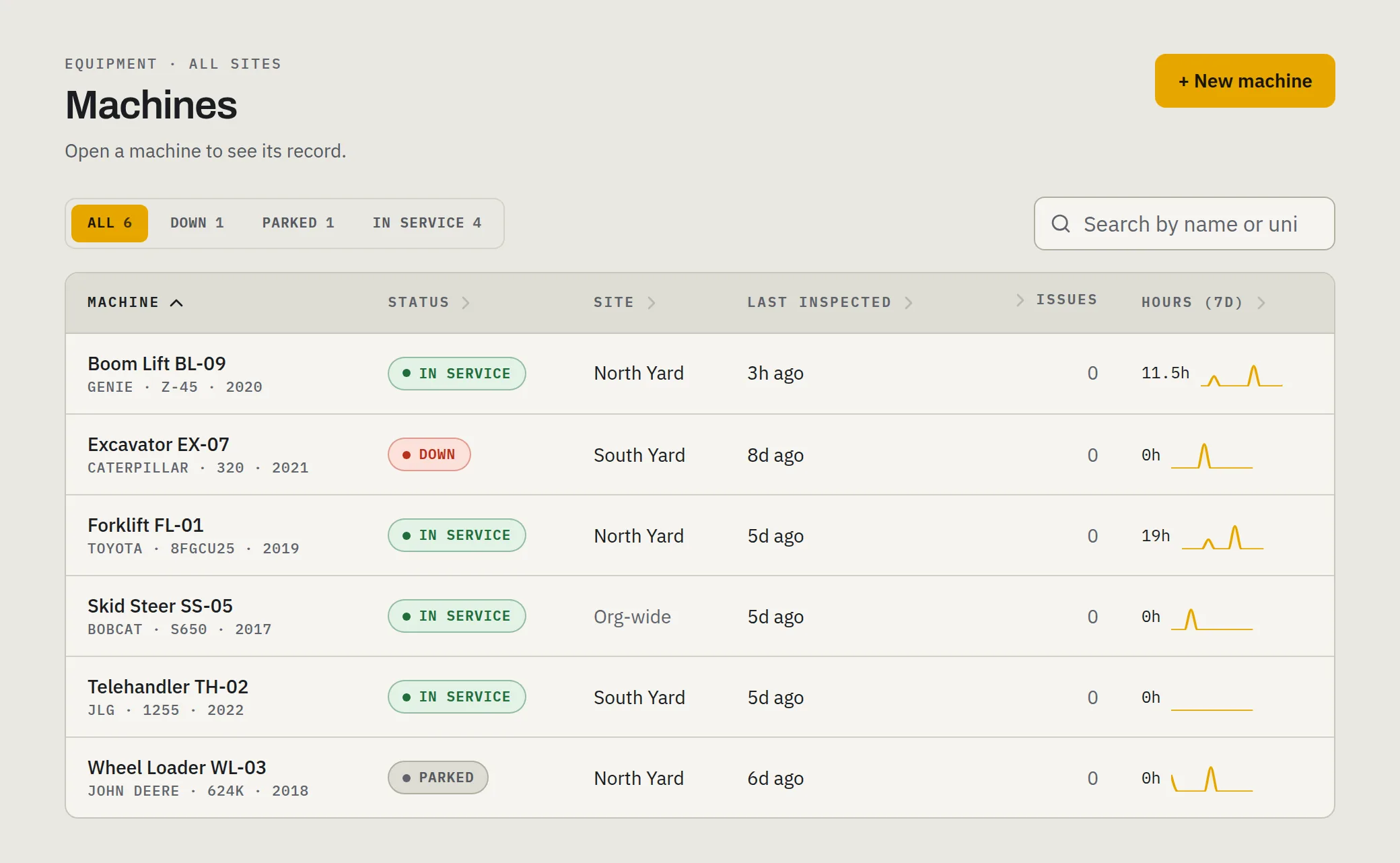
You build the checklist once in wearpoint as an inspection template for the category: one loader template, in your own words and the order your crew walks the machine, and every loader uses it. Each item takes a verdict of OK, Issue, or N/A, and a defect gets a quick note. Open defects carry forward to the next inspection until the fix is recorded.
The operator raises a defect as an issue in one tap and the shop triages it into a work order. Owners and the people responsible get an alert when a machine goes down, and a machine marked down can’t be started from the app until it’s repaired. Operators tap in on the machine and enter the hour-meter reading when they tap out, so service comes due on the hours the loader actually ran. When an operator takes over mid-shift, they run their own inspection, and the day shows two records.