Snow equipment pre-season checklist
The first storm is the worst time to find a dead block heater, a cracked trip edge, or a loader that ran past its service in the first week. A pre-season check is a walk around every machine you’ll run this winter, on your time instead of the storm’s, with a note of what needs fixing before the phone starts ringing.
This checklist goes machine by machine. It is a starting point: your operator’s manual lists the pre-season and cold-weather items for each model, and it is the authority wherever the two differ.
Start with the numbers
Before anyone picks up a wrench, read the hour meter on every machine and note the hours remaining to its next service. A loader a few dozen hours short of its next service will reach it in the first big storm week, when it can least be spared — do that service now. Flag any machine whose meter doesn’t read or doesn’t move: the service schedule is only as good as the meter behind it.
Wheel loaders with pushers
- Pusher box — moldboard, side panels, and the welds between them. A bent or cracked section opens up under load.
- Cutting edges and trip edge — edge wear against the wear limit, missing or loose bolts, and a trip edge (or trip springs) that trips and returns freely instead of rusting in place.
- Side-panel wear shoes — a shoe worn through grinds the panel itself.
- Coupler and pins — the coupler locks fully onto the pusher, the locking pins or wedges engage, and the indicator, where there is one, shows locked.
- Lift arms, cylinders, and hoses — hoses that sat all summer crack at the bends; look for chafing where they cross the frame. Look for leaks; never feel for them.
- Articulation joint — pins and bushings greased, and the articulation lock stowed for work.
- Tires and chains — cuts and tread; chains fitted, with tensioners and repair links on hand.
- Cab — heater and defroster at full output, wipers and washer, glass and mirrors, door seals. The operator spends a long shift in there, in the dark.
- Lights, beacon, backup alarm, and horn — every one of them. The work happens at night, next to traffic and people on foot.
Skid steers and compact track loaders
- Tracks or tires — track tension, rollers and idlers turning, and no packed debris left to freeze solid in the undercarriage; tire cuts and pressure.
- Lift arms, pins, and bushings — grease them, and check the pivots for play.
- Quick-attach — levers or pins fully engaged through the attachment plate, every time the attachment changes.
- Attachments — the blade’s cutting edge and angle cylinders; the blower’s auger, impeller, shear bolts, and chute rotation; the broom’s bristle wear.
- Auxiliary hydraulics — couplers clean, capped, and not weeping.
- Seat bar and interlocks — lower the bar and confirm the lift and drive interlocks work.
- Cab — heater, door seal, and wipers on an enclosed cab; work lights front and rear.
Sidewalk tractors
A sidewalk machine works a hand’s width from curbs, posts, and doorways, so the checks that matter most are the ones that keep it steering straight and keep it seen.
- Front attachment — the V-blade’s cutting edges and trip, or the blower’s auger, impeller, and shear bolts.
- Mounted spreader, if fitted — hopper, conveyor or auger, spinner, and gate move freely and aren’t caked with last spring’s salt.
- Articulation, steering, and tracks or tires — play in the steering is play on the sidewalk.
- Mirrors, lights, beacon, and backup alarm — sidewalks mean people on foot.
- Cab heat, defrost, and wipers
Backhoes and graders on snow duty
- Backhoe loaders — treat the loader end like any loader with a pusher or blade, check that the boom and swing locks hold the backhoe end for travel, and make sure the stabilizers stow fully.
- Graders — moldboard and cutting edges, the front plow mount, and the wing if fitted (wing post, hinge pins, and its hydraulics); wear on the circle and drawbar; chains.
The units working alongside them
Tow-behind and skid-mounted spreaders, brine units, and light towers get checked with the machines they work beside, even though none of them drives itself.
- Spreaders — spinner, conveyor or auger, gate, and controls; the drive motor or engine serviced; last season’s material cleaned out.
- Brine units — pump, hoses, nozzles, and valves flushed and tested; the tank clean.
- Light towers — engine serviced, the mast raises and lowers, every lamp works, and the outriggers deploy.
Cold-weather fluids, fuel, and batteries
Follow each machine’s operator’s manual for its winter needs: the engine oil grade, coolant protection, winter fuel, and diesel exhaust fluid handling where it applies. Then, whatever the manual specifies, check on every machine:
- Coolant — tested for freeze protection, not assumed.
- Fuel — water drained from the separators, and the tank kept full to limit condensation.
- Batteries — load-tested, with the terminals clean and tight.
- Block heaters and cords — they heat, and the cords aren’t cut or crushed.
- Grease — every point on the lube chart, before the first storm packs them with slush.
 wearpoint
Rentals and subcontracted machines
A machine that arrives for the season gets the same walk before its first shift on your lots. Record its hour meter at intake and note the damage it came with: the same record settles the argument when it goes back. The guide to snow removal hour logs covers keeping those machines’ hours in your own record.
In season: the walkaround before every shift
The pre-season check happens once. The walkaround before each shift does not: the scope note at the top of this page sets out what Alberta, BC, and Quebec require of these machines. At 3 a.m., the walkaround has to be short enough that it actually happens.
How wearpoint runs it
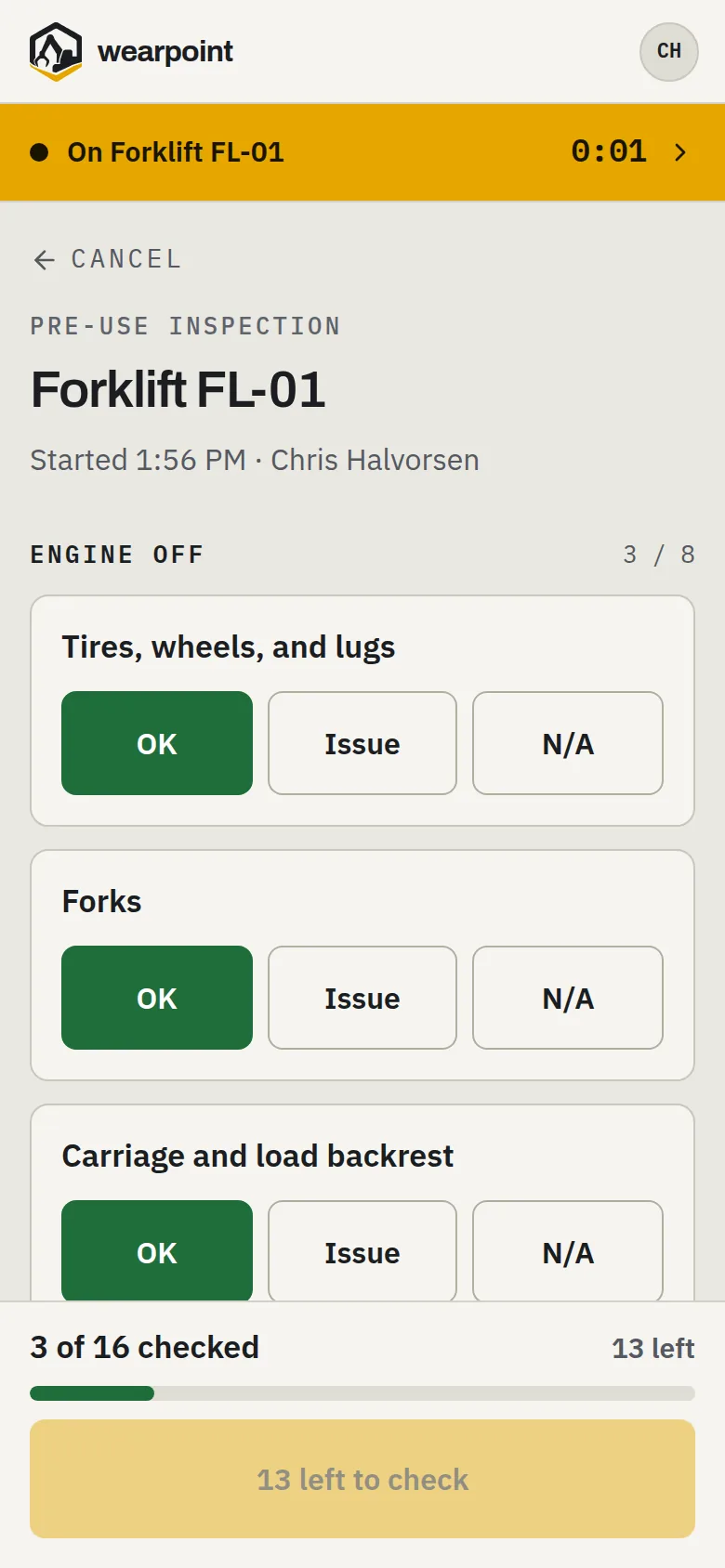
Build each machine class’s checklist once as a category template — one for loaders, one for sidewalk tractors — and every machine in that category uses it. Operators tap in on the machine they’re running and enter the hour-meter reading when they tap out, so each machine’s page shows its hours remaining to every scheduled service. A defect becomes an issue in one tap, the shop triages it into a work order, and a rented machine keeps its own record for as long as you have it. See how it fits the machines a snow operation runs.