Sidewalk tractor daily inspection checklist
A sidewalk tractor is a small articulated machine doing a big machine’s work in the narrowest place on the route: between a curb and a front door, often at night, often with people walking past. The daily check is about the front attachment that’s on it tonight, the spreader on the back, the articulation that keeps it steering straight, and the cab, lights, and alarms that let the operator see and be seen.
Your operator’s manual is the authority on the model-specific items, the shear bolts, and the settings. The snow equipment pre-season checklist covers the once-a-year work before the first storm; this list is the one you run at the start of every shift. The table after the checklist sets out what each province and US OSHA asks, rule by rule.
Engine off — the walkaround
- Block heater cord — unplugged and stowed before anything else; driving off plugged in tears out the cord and the outlet with it.
- Articulation and steering cylinders — pins and bushings greased, no play at the joint, cylinder rods clean, no cracked welds or loose mounts.
- Tires, chains, or tracks — cuts and tread, chains tight with no broken cross-links; on tracks, tension and no packed ice in the undercarriage.
- Hoses — no chafing where they bend at the articulation and run to the front mount; look for leaks, never feel for them.
- Fluids — engine oil, hydraulic oil, coolant, and fuel at their marks; fresh snow under the machine shows any drip.
- Glass, mirrors, and door — glass clear of frost and cracks, mirrors there and set, door latching and sealing.
- Seat belt — present, latching, retracting, and not frayed or frozen stiff.
Front attachment and spreader
Check whichever attachment is on the machine tonight and mark the others N/A. Clear a blower or spreader only with the engine off and the tool made for it, never by hand.
- V-blade edges and trip — cutting edges inside their wear limit, bolts tight, and each wing trips and returns instead of sitting frozen.
- Blower auger, impeller, chute — auger and impeller free of ice and debris, shear bolts present and the right ones, chute and deflector turning.
- Broom bristles — worn evenly, core not showing, nothing wound into the broom.
- Attachment mount and pins — pins in and retained, locks engaged, no cracks at the mount or the front frame.
- Mounted spreader — hopper free of caked salt, conveyor or auger and spinner turn freely, gate opens and closes fully.
Engine on — the function checks
- Heater, defroster, and wipers — full heat, the windshield clear before you leave, wipers and washer working.
- Lights, beacon, backup alarm, horn — headlights, work lights, beacon, alarm, and horn all working; most routes run in the dark.
- Service and park brakes — the machine stops straight and holds on a grade with the park brake set.
- Steering — full lock both ways with no lag or play: play in the steering is play on the sidewalk.
- Attachment functions — blade lifts and angles, blower spins up and chute turns, broom turns; spreader spins and the gate answers.
- Gauges and warning lights — nothing lit that shouldn’t be; hour meter reading noted.
Around the machine
- The route — curbs, posts, hydrants, doorways, low signs, and anything new since last night now buried under the snow.
- People on foot — where you’ll meet them: bus stops, school entrances, building doors at shift change.
- Icy grades — ramps and slopes where the machine could slide; plan to spread before you climb and go down slowly.
 wearpoint
What the rules ask, jurisdiction by jurisdiction
Do this walkaround before every shift. Where a rule below doesn’t name a daily inspection, it often requires the machine to be inspected or used according to the manufacturer’s instructions — so check what your operator’s manual calls for before each shift.
Each row is what one regulation asks of this machine, in plain words, with a link to the text. Where a rule depends on the kind of site or machine, the row says so: check it against your own. This is a summary, not legal advice — the regulation and your operator’s manual govern.
Alberta
Before operating powered mobile equipment, the operator must complete a visual inspection of the equipment and the surrounding area. OHS Code s.257(1)
British Columbia
Before mobile equipment is first operated on a shift, the operator must inspect it and report any unsafe or potentially unsafe defect to the supervisor or employer, then keep monitoring it while it runs. The employer keeps a record of reported defects for at least 2 years. OHSR 16.3(1)–(3)
Ontario
Construction projects: No vehicle or machine may be used while it is defective or hazardous, and it must be used as its manufacturer’s operating manual says. Powered equipment rated over 10 horsepower must be inspected by a competent worker before it is first used at the project, then at least once a year or more often if the manufacturer recommends. Neither section sets a daily inspection. O. Reg. 213/91 ss.93–94
Every workplace: The employer must keep the equipment it provides in good condition, and a worker must report a known defect that may endanger a worker to the employer or supervisor. OHSA ss.25(1)(b), 28(1)(c)
Quebec
Construction sites: Any self-propelled vehicle or equipment driven by a power source other than manual must be checked by an experienced person before its first use on the site, then daily whenever it is used. CSTC s.3.10.1(b)
Elsewhere, such as a yard or plant: A self-propelled vehicle must be inspected and maintained according to the manufacturer’s instructions or standards offering equivalent safety. Section 272 sets no inspection frequency of its own. RSST s.272
Nova Scotia
The employer must ensure powered mobile equipment and forklifts are operated, inspected, serviced, maintained, and repaired according to the manufacturer’s specifications, or specifications certified by an engineer. N.S. Reg. 44/99 s.55
United States (federal OSHA)
Construction sites: The employer’s safety program must provide for frequent and regular inspections of equipment by competent persons it designates. Equipment that doesn’t comply with OSHA’s construction rules may not be used and must be tagged, have its controls locked, or be removed. 29 CFR 1926.20(b)(2)–(3)
Not in the table yet: Saskatchewan, Manitoba, New Brunswick, Prince Edward Island and Newfoundland and Labrador. We add a province once its official text has been checked.
Working a hand’s width from people
Most heavy equipment works where people on foot are kept away. A sidewalk tractor works where they are: the sidewalk, the plaza, the entrance to the clinic. The cab sits low and close to the attachment, and a V-blade or blower chute blocks part of the view ahead. A person in a dark coat, head down against the wind, earbuds in, does not hear a small machine coming.
So the lights, the beacon, and the backup alarm are not extras on this machine; they are how anyone knows you’re there. Keep the glass and mirrors clear for the whole shift, not just at the start. Slow down wherever the route meets doorways, bus stops, and corners you can’t see around. When someone steps into your path, stop and let them pass; don’t steer around them with the blade angled. Reversing is where the blind spots are worst, so look before you back up, every time. On a blower, know where the chute is pointed: it throws ice and gravel hard enough to break a window or hurt someone.
Salt eats machines
A sidewalk tractor lives in salt. It spreads it, drives through it, and sprays it up into every pin, connector, and weld. Left on overnight, wet salt starts working on steel and wiring before the next shift.
Wash the machine down when the shift allows, and the spreader every time: empty the hopper, rinse the conveyor or auger and the spinner, and work the gate so it doesn’t seize. Once it’s clean, look for what the salt has been doing: rust-through on the spreader’s hopper seams, spinner, and frame; rust lifting the paint around welds on the main frame and the attachment mount; green corrosion or cracked boots on the electrical connectors at the lights, the spreader controls, and the articulation. A flickering beacon in February is usually a connector, not a bulb. Your manual says how to protect the connectors and which points to grease; follow it.
When something fails
A sidewalk tractor that fails its check comes out of service. Tag it where the next operator will see it, take the key, and report it to your supervisor. Only a qualified mechanic repairs it. A defect noted but left running — a dead backup alarm, a sticking trip on the V-blade, steering with play in it — is the one that hurts someone.
How wearpoint runs this checklist
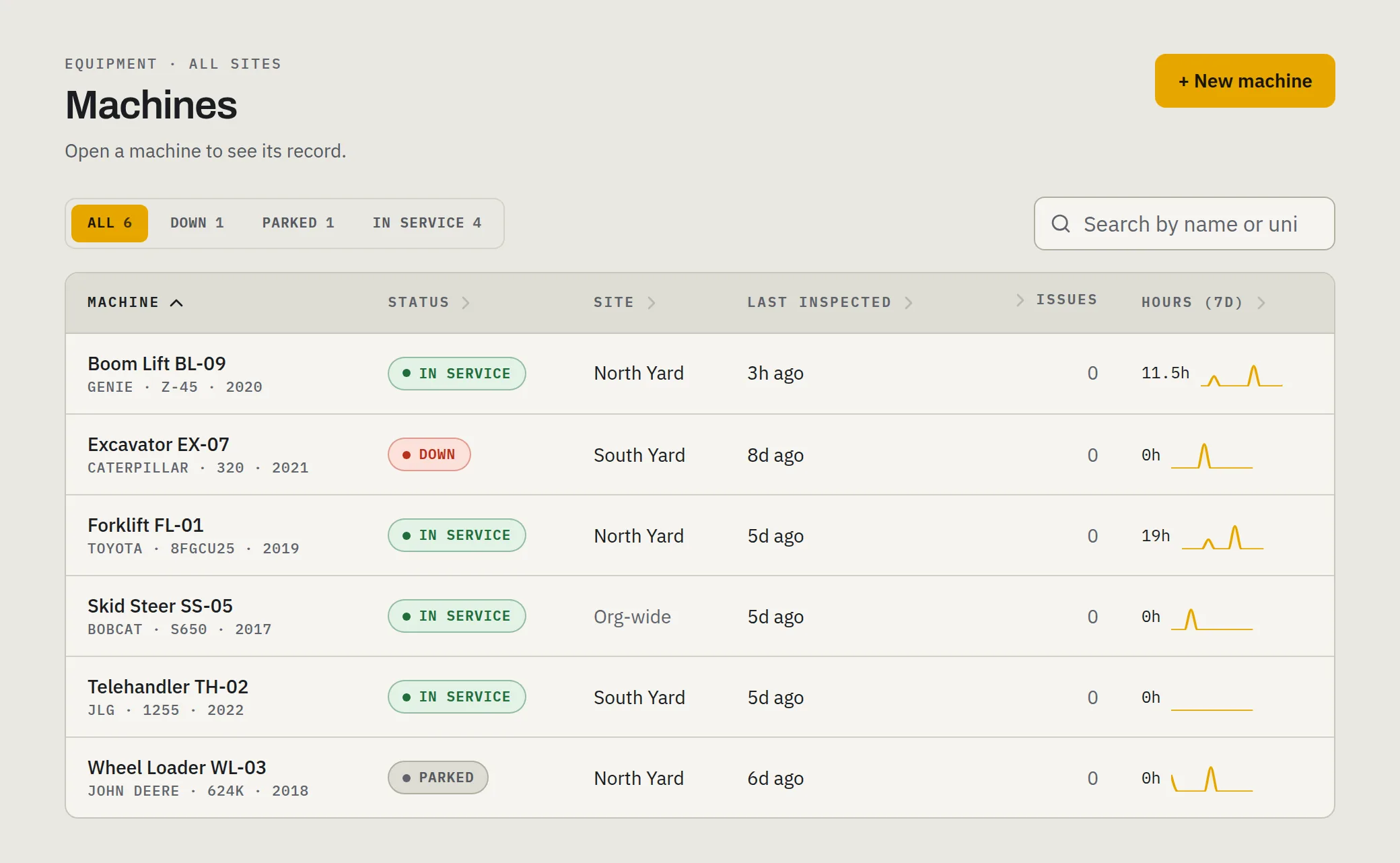
You build the sidewalk tractor checklist in wearpoint once, as an inspection template for the category, in your own words and walk order, and every sidewalk tractor uses it. Every item takes a verdict — OK, Issue, or N/A — so the blower items go N/A on a night the machine runs a blade. A defect is flagged with a quick note, and open defects carry forward to the next inspection until the fix is recorded. The operator raises a defect as an issue in one tap, the shop triages it into a work order, the people responsible get an alert when a machine goes down, and a machine marked down can’t be started from the app until it’s repaired.
Operators tap in on the machine and enter the hour-meter reading when they tap out, so service comes due on the hours it actually ran, storm weeks included. If a second operator takes the machine mid-storm, they run their own inspection, and that’s a second record. See how it fits the machines a snow operation runs.