Backhoe loader daily inspection checklist
A backhoe loader is two machines on one frame: a loader on one end and a small excavator on the other, sharing one engine, one set of tires, and one operator who usually favours one end over the other. The daily check covers both ends whether or not you plan to use both today, plus the parts that only a backhoe has: the stabilizers, the king post the hoe swings on, the swivel seat, and the locks that hold the hoe still while the machine moves around the site.
This list is a starting point in walk order. Your operator’s manual is the authority for model-specific items, grease points, and any figure you’re checking against. The table after the checklist sets out what each province and US OSHA asks, rule by rule.
Engine off — the walkaround
Start at the loader bucket and work back to the hoe. Buckets on the ground, or the hoe resting on its lock, before you get near either end.
- Loader bucket and cutting edge — cracks in the bucket shell and welds, cutting edge worn or loose, bolts missing, bolt-on teeth bent or gone.
- Loader arms and coupler — lift arms straight and crack-free, pins and retainers in place, coupler pins fully engaged and the indicator showing locked.
- Boom and dipper — cracks at welds and pin bosses; on an extendable dipper, wear pads, scoring on the inner section, and the extension lock.
- Hoe bucket and teeth — teeth and adapters tight, none missing or worn to stubs, side cutters secure, bucket pins and linkage retained.
- Swing linkage and king post — swing cylinders, linkage, and king post pins greased and retained, no fresh play. Look from outside the swing arc; never reach in.
- Stabilizers and pads — legs straight, pins retained, pads present and turned the right way: flat side for pavement, grouser side for dirt.
- Boom lock and swing lock — both present and working, pins or latches not bent, seized, or missing.
- Tires and wheel nuts — cuts, bulges, and sidewall damage, inflation looking even, no missing or rust-streaked wheel nuts.
- Hoses and cylinders — chafe, bulges, and wet fittings from the loader arms back to the hoe. Look for leaks with your eyes, never your hand.
- Fluids — engine oil, hydraulic oil, coolant, and fuel levels, then a look underneath for anything fresh on the ground.
- Steps, handrails, glass, mirrors — steps clear of mud and ice, handrails tight, cab glass uncracked, mirrors clean and set.
Engine on — the function checks
- Both stations and seat lock — the seat locks facing each station; loader and hoe controls each respond, and nothing moves with the controls in neutral.
- Stabilizers up and down — both legs lower and raise evenly, and hold the machine without settling.
- Full travel and drift — loader and hoe through every function, smooth, with no drift once the controls are released.
- Steering and four-wheel drive — steering firm lock to lock; four-wheel drive engages and releases, if fitted.
- Service and park brakes — the machine stops straight and holds on the park brake.
- Horn, alarm, and lights — horn, travel alarm, work lights, and beacon all working.
- Gauges and seat belt — no warning lights left on, hour meter noted, belt latching and not frayed.
Around the machine
- Swing radius — the hoe’s full arc clear of walls, stockpiles, and people; mark it off where others work close.
- Buried services located — locates done and the marks still visible before the bucket goes in; dig near them the way your site procedure sets out.
- Overhead lines — power lines over the dig and the route there, and how high the boom will reach.
- Trench and excavation edges — stabilizers set back from any edge; cracks, water, or an undercut wall mean the ground won’t hold the machine.
 wearpoint
What the rules ask, jurisdiction by jurisdiction
Do this walkaround before every shift. Where a rule below doesn’t name a daily inspection, it often requires the machine to be inspected or used according to the manufacturer’s instructions — so check what your operator’s manual calls for before each shift.
Each row is what one regulation asks of this machine, in plain words, with a link to the text. Where a rule depends on the kind of site or machine, the row says so: check it against your own. This is a summary, not legal advice — the regulation and your operator’s manual govern.
Alberta
Before operating powered mobile equipment, the operator must complete a visual inspection of the equipment and the surrounding area. OHS Code s.257(1)
British Columbia
Before mobile equipment is first operated on a shift, the operator must inspect it and report any unsafe or potentially unsafe defect to the supervisor or employer, then keep monitoring it while it runs. The employer keeps a record of reported defects for at least 2 years. OHSR 16.3(1)–(3)
Ontario
Construction projects: No vehicle or machine may be used while it is defective or hazardous, and it must be used as its manufacturer’s operating manual says. Powered equipment rated over 10 horsepower must be inspected by a competent worker before it is first used at the project, then at least once a year or more often if the manufacturer recommends. Neither section sets a daily inspection. O. Reg. 213/91 ss.93–94
Every workplace: The employer must keep the equipment it provides in good condition, and a worker must report a known defect that may endanger a worker to the employer or supervisor. OHSA ss.25(1)(b), 28(1)(c)
Quebec
Construction sites: Any self-propelled vehicle or equipment driven by a power source other than manual must be checked by an experienced person before its first use on the site, then daily whenever it is used. CSTC s.3.10.1(b)
Elsewhere, such as a yard or plant: A self-propelled vehicle must be inspected and maintained according to the manufacturer’s instructions or standards offering equivalent safety. Section 272 sets no inspection frequency of its own. RSST s.272
Nova Scotia
The employer must ensure powered mobile equipment and forklifts are operated, inspected, serviced, maintained, and repaired according to the manufacturer’s specifications, or specifications certified by an engineer. N.S. Reg. 44/99 s.55
United States (federal OSHA)
General industry: OSHA’s forklift standard does not apply to vehicles intended primarily for earth moving, and OSHA has said front-end and backhoe loaders stay outside it even with forks fitted. 29 CFR 1910.178(a)(1); OSHA interpretation, 1999-10-21
Construction sites: OSHA’s earthmoving equipment rules set no inspection interval of their own. 29 CFR 1926.602(a)
Construction sites: The employer’s safety program must provide for frequent and regular inspections of equipment by competent persons it designates. Equipment that doesn’t comply with OSHA’s construction rules may not be used and must be tagged, have its controls locked, or be removed. 29 CFR 1926.20(b)(2)–(3)
Not in the table yet: Saskatchewan, Manitoba, New Brunswick, Prince Edward Island and Newfoundland and Labrador. We add a province once its official text has been checked.
Two machines, one walk
Walk both ends, every time. Most backhoe operators have a favourite end. Someone loading all day treats the hoe as ballast; someone digging footings barely looks at the loader bucket. But the end you aren’t using is still bolted to the machine, still full of pressurized oil, and still able to move. A cracked loader arm or a weeping swing cylinder doesn’t care which seat you sat in this morning.
The hoe end is where wear hides. The king post pins and the swing cylinders take every side load the bucket ever sees, and play there shows up as a bucket that won’t hold a line in the trench. Look for shiny metal around the pin bosses, grease that has been pushed out dry, and cracks starting at welds. Do it from outside the swing arc, with the hoe down or on its lock: never reach in between the frame and the boom.
Before you move the machine anywhere on site, lock the hoe for travel. Boom lock in, swing lock in, stabilizers fully up, hoe bucket curled in, and the seat locked facing the loader controls. An unlocked hoe swinging on a rough haul road is how a backhoe takes out a fence, a light standard, or the person walking beside it. If either lock is bent, seized, or missing, that is a defect, not an inconvenience.
The stabilizer pads matter more than they look. Reversible pads have a flat face for pavement and a grouser face for dirt. The wrong face on asphalt chews up the surface; on soft ground it lets the machine slide while you dig. The excavator checklist goes deeper on digging-end wear if you run both kinds of machine.
When something fails
Take the machine out of service. Tag it where the next operator will see it, at the loader controls and the hoe controls both, take the key, and report it to your supervisor. Only a qualified mechanic repairs it. A defect that gets noted and then run anyway is the one that hurts someone, so the tag stays on until the repair is done.
How wearpoint runs this checklist
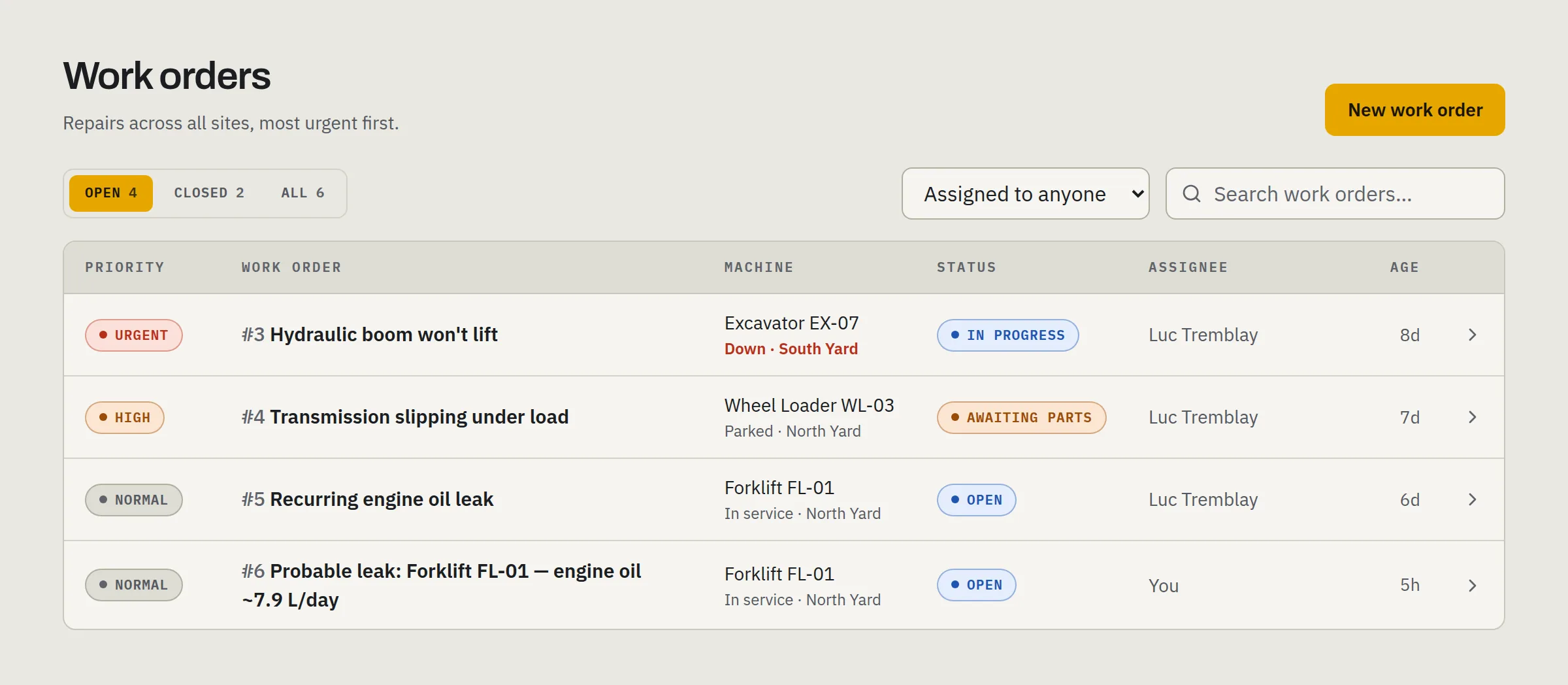
You build the backhoe checklist once in wearpoint as an inspection template, in your own words and the order your crew walks it, and every backhoe in that category uses it. Every item takes a verdict: OK, Issue, or N/A. A defect is flagged with a quick note, and open defects carry forward to the next inspection until the fix is recorded. The operator raises a defect as an issue in one tap, the shop triages it into a work order, and the people responsible get an alert when a machine goes down. A machine marked down can’t be started from the app until it’s repaired.
Operators tap in on the machine and enter the hour-meter reading when they tap out, so service comes due on the hours the backhoe actually ran. Add a hydraulic oil top-up line to the template and every litre added gets logged; when one machine’s top-ups over a week run at three times its own 30-day norm, wearpoint flags a probable leak. It tells you which backhoe to look at. It doesn’t find the hose for you.