Boom lift pre-use inspection checklist
A boom lift puts a person at the end of a long lever, sometimes well out past the wheels, with the only way down running through the hydraulics you’re about to inspect. This checklist covers telescopic and articulating self-propelled booms, diesel, electric, or hybrid. The walkaround happens with the power off, the function checks with it on, and the function checks start at the ground controls, not in the basket.
Smaller platforms that go straight up have their own list in the scissor lift checklist. For anything model-specific — the tilt alarm test, the emergency lowering procedure, the wind limit — your operator’s manual is the authority, and it belongs in its box on the machine. The table after the checklist sets out what each province and US OSHA asks, rule by rule.
Power off — the walkaround
Boom stowed, platform at rest, key off.
- Tires, wheels, and chassis — cuts and chunking, foam-filled tires not split, every wheel nut there; no cracked welds or bent covers on the chassis.
- Turntable and its lock — no cracks around the turntable, bearing bolts all there; the turntable lock works and is released for work.
- Boom sections and jib — straight, no dents or cracked welds; jib and platform rotator move freely; cables and hoses in the boom aren’t pinched.
- Pins, retainers, and wear pads — every pin in place with its retainer; wear pads present; no fresh shavings at the pivots or the boom nose.
- Cylinders and hoses — rods clean and unscored, fittings dry, no chafing where hoses flex. Look for leaks; never feel for them by hand.
- Guardrails, gate, and toe boards — rails tight and unbent, toe boards intact; the gate swings shut and latches, or the chain clips across.
- Harness anchor points — the marked anchors on the platform are undamaged, not bent or cracked, and not tied off for anything else.
- Platform controls and guard — control box secure, guard around the joystick intact, labels readable, cable not chafed where it runs to the platform.
- Decals and manual box — capacity decal and warnings legible; the operator’s manual in its box on the machine, not in the site trailer.
- Fuel or battery charge — enough fuel or charge for the shift; battery connections tight and clean; the charger cord unplugged and stowed.
Power on — the function checks
Test from the ground controls first, with nobody on the platform.
- Ground controls, every function — boom up, down, extend, swing, jib and platform rotate, each smooth and stopping when you let go.
- Emergency stop, both stations — the ground and platform emergency stops each kill every function, and reset.
- Emergency lowering — the emergency or auxiliary lowering works the way your manual describes, and the person on the ground knows how.
- Platform controls and enable — nothing moves until the foot switch or enable is held; every function responds from the platform.
- Drive, steer, and brakes — drives both ways, steers lock to lock, and the brakes hold when you release the control.
- Tilt alarm and overload sensing — the tilt alarm sounds when your manual’s test says it should; overload sensing responds, if fitted.
- Elevated drive speed — with the boom raised out of stowed, drive speed drops to its slow range.
- Horn, travel alarm, and beacon — all three working; on a busy site, the horn is how the platform talks to the ground.
Around the machine
- Overhead lines and obstructions — power lines, beams, pipe racks, and ceilings within the boom’s full reach and swing, not just above the platform.
- Ground under the machine — slope, holes, soft ground, trench edges, and covers or plates that won’t carry the wheel load.
- Wind — gusts at working height, not at the ground; your manual sets the wind limit for the machine.
- People and machines below — who works under the boom and where other machines travel; barricade the area if you have to.
 wearpoint
What the rules ask, jurisdiction by jurisdiction
Do this walkaround before every shift. Where a rule below doesn’t name a daily inspection, it often requires the machine to be inspected or used according to the manufacturer’s instructions — so check what your operator’s manual calls for before each shift.
Each row is what one regulation asks of this machine, in plain words, with a link to the text. Where a rule depends on the kind of site or machine, the row says so: check it against your own. This is a summary, not legal advice — the regulation and your operator’s manual govern.
Alberta
Self-propelled lifts: The Code’s powered mobile equipment includes a self-propelled machine designed to provide a powered aerial device for workers. If your lift fits that definition, the operator must visually inspect it and the surrounding area before operating it. OHS Code ss.1, 257(1)
British Columbia
An elevating work platform not designed for highway travel is excluded from the mobile equipment rules in Part 16. Elevating work platforms come under Part 13, where a work platform must be inspected before use on each shift and after any modification, and any condition that might endanger workers must be fixed before it is used. OHSR 16.1, 13.1, 13.3
A self-propelled boom-supported or vehicle-mounted platform must also be inspected at least every 12 months and certified in writing by the manufacturer or a professional engineer. OHSR 13.23(1)
Ontario
Construction projects: An elevating work platform must be inspected each day before use, following the manufacturer’s instructions, by a worker trained to operate it, and the owner keeps a permanent record of every inspection, test, repair, modification, and maintenance. From January 1, 2027, these rules move to a new regulation, O. Reg. 117/26, with the same daily inspection. O. Reg. 213/91 ss.144(3)(b), 145(2)
Every workplace: The employer must keep the equipment it provides in good condition, and a worker must report a known defect that may endanger a worker to the employer or supervisor. OHSA ss.25(1)(b), 28(1)(c)
Quebec
Construction sites: The operator must give a hoisting apparatus a visual inspection and an operational test, as the manufacturer instructs, each day it is used. The Code’s definitions give as examples forklifts (platform or fork), self-propelled articulating or telescopic boom platforms, and self-propelled scissor platforms; any other apparatus designed to lift materials or people counts too. CSTC ss.1.1, 2.15.1(1)(e)
Elsewhere, such as a yard or plant: A lifting apparatus — the definition includes forklifts and elevating platforms — must be checked before its first use, then inspected and maintained according to the manufacturer’s instructions or standards offering equivalent safety. RSST ss.1, 245
Construction sites: The owner of a personnel lifting apparatus keeps a register of its inspections and repairs, and a mobile elevating work platform needs a structural inspection under CSA B354.7 ten years after it was made and every five years after that. CSTC ss.2.15.12(8), 2.15.16
United States (federal OSHA)
Construction sites, and vehicle-mounted platforms in general industry: The lift controls must be tested each day before use to make sure they are in safe working condition. 29 CFR 1926.453(b)(2)(i), 1910.67(c)(2)(i)
Not in the table yet: Saskatchewan, Manitoba, New Brunswick, Nova Scotia, Prince Edward Island and Newfoundland and Labrador. We add a province once its official text has been checked.
Ground controls first
Run every function from the ground controls before anyone steps onto the platform. If the boom stutters on extend or a swing motor groans, you want to find out with both feet on the ground, not halfway up a building with the platform pinned against a beam. The ground station is also the way somebody brings you down if you can’t bring yourself down: if you’re hurt, if the platform controls fail, if you’re caught against something overhead.
That only works if someone is down there who knows how. Before you go up, the person staying on the ground should know where the ground controls are, how to switch the selector from platform to ground, and how to work the emergency lowering. Walk them through it during the function check, while it’s easy, then set the selector back to the platform. A spotter who has never touched the ground controls is a spotter with nothing to do but watch.
Harness and lanyard
Inspect your own harness and lanyard before you clip in, every time, even if you checked them yesterday. Run the webbing through your hands looking for cuts, burns, fraying, paint or chemical damage, and pulled or broken stitching. Check the buckles and D-ring for cracks or distortion, and make sure the snap hooks close on their own and lock. If the lanyard’s energy absorber pack is torn open or stretched, it has already stopped a fall and it’s done. So is a harness that has caught one.
Clip to the anchor point the manufacturer marked on the platform — not to a guardrail, not to the boom, and not to a structure beside you. Keep the lanyard as short as the work allows, and stay with your feet on the platform floor; standing on the rails or a bucket to gain reach defeats the whole system.
When something fails
Take the machine out of service. Tag it at both control stations where the next operator will see it, take the key, and report it to your supervisor. Only a qualified mechanic repairs it. An emergency stop that doesn’t stop, a tilt alarm that stays quiet, or a platform that creeps down is not a note for later. The defect that gets written down and left running is the one that hurts someone.
How wearpoint runs this checklist
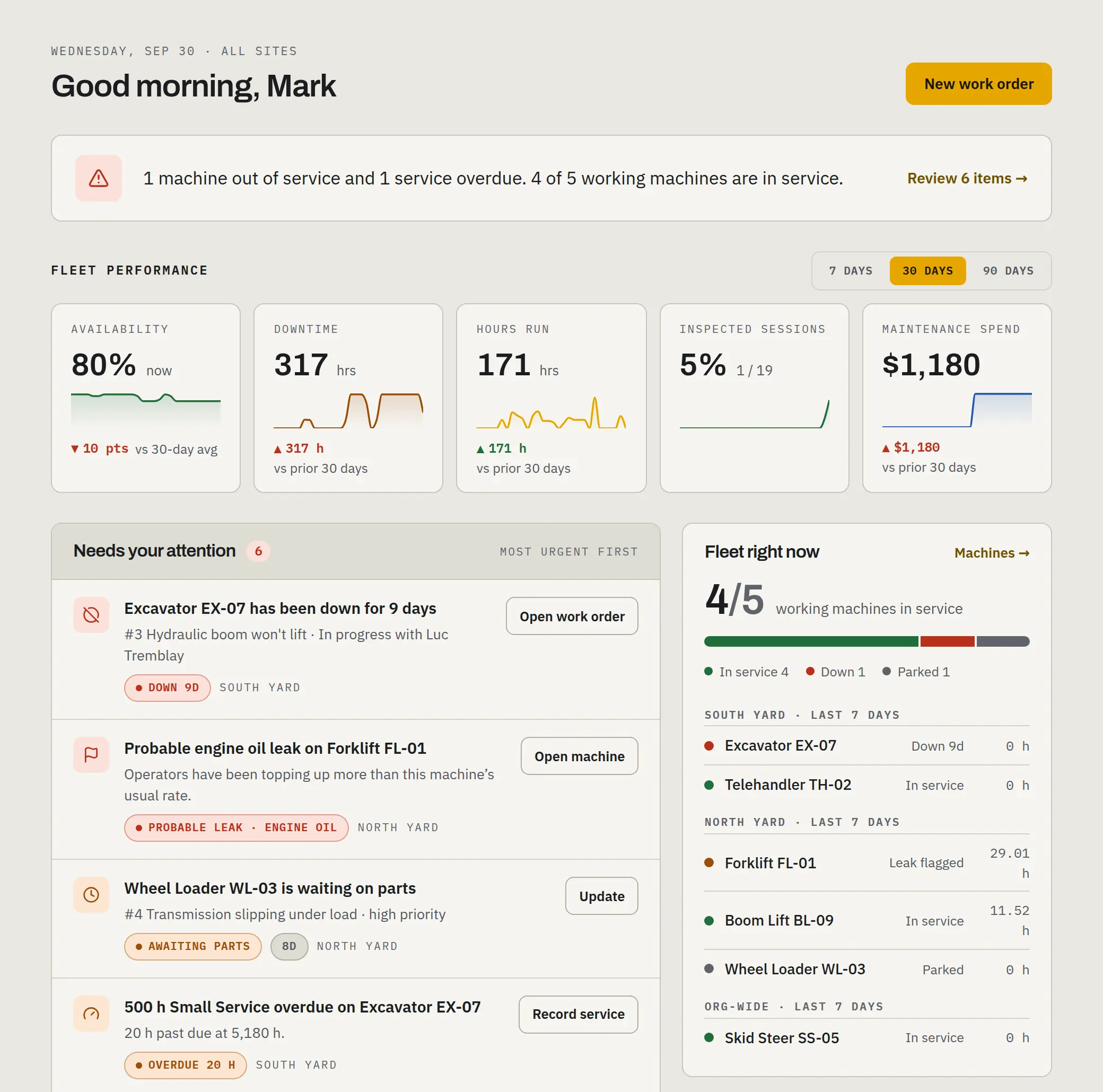
You build the checklist once in wearpoint as an inspection template for your boom lifts, in your own words and your crew’s walk order, and every boom lift uses it. Every item takes a verdict: OK, Issue, or N/A. A defect is flagged with a quick note, and open defects carry forward to the next inspection until the fix is recorded. The operator raises a defect as an issue in one tap; the shop triages it into a work order; the people responsible get an alert when a machine goes down, and a machine marked down can’t be started from the app until it’s repaired.
Operators tap in on the machine and enter the hour-meter reading when they tap out, so service comes due on the hours each lift actually ran. A top-up line for hydraulic oil logs the litres added; when a machine’s top-ups over a week run at three times its own 30-day norm, wearpoint flags a probable leak and tells you which lift to look at. It doesn’t diagnose the hose. An operator who takes over mid-shift runs their own inspection, and it stands as its own record.