Scissor lift pre-use inspection checklist
A scissor lift is the simplest machine on most sites, which is exactly why its check gets skipped. It only goes up and down, it runs quietly on batteries, and it is usually the machine somebody grabs for a quick job before lunch. But it puts people on a platform over a concrete floor, and the few safety systems it has — the pothole guards, the tilt alarm, the emergency lowering, the gate that shuts itself — only help if they work.
This list is written mostly for electric slab scissors and rough-terrain units, so the walkaround is done with the power off and the function checks with it on. Your operator’s manual is the authority for your model: the hydraulic oil mark, the tilt alarm test, the charging routine. The table after the checklist sets out what each province and US OSHA asks, rule by rule.
Power off — the walkaround
Platform fully lowered, key off, charger unplugged.
- Battery, connectors, and charger cord — charged for the shift; terminals clean and tight, no acid crust; charger cord unplugged, undamaged, and stowed.
- Hydraulic tank level — oil at the mark your manual shows, with the platform fully lowered.
- Tires and chassis — no cuts or chunks, non-marking tires on slab machines; no cracked welds, bent covers, or loose panels.
- Scissor arms, pins, and bushings — arms straight and uncracked, every pin and retainer in place, no bushing walking out; nothing caught in the stack.
- Maintenance safety arm — stowed in its bracket and able to swing out; never reach into the stack unless the arm is set.
- Guardrails, toe boards, and anchors — rails pinned and tight, toe boards intact, anchor points undamaged.
- Self-closing gate — swings shut on its own and latches; nobody has tied it open.
- Extension deck and lock — slides in and out freely, its rails intact, and the lock holds it at every position.
- Manual box and decals — operator’s manual in its box on the machine; capacity decal, indoor or outdoor rating, and warnings legible.
Power on — the function checks
Ground controls first, with nobody on the platform.
- Ground controls — raise and lower from the ground station, smooth and stopping when you let go.
- Emergency stop at both stations — the ground and platform stops each cut every function, and reset.
- Emergency lowering — the emergency lowering brings the platform down the way your manual describes; know where its handle or valve is.
- Platform controls with enable — nothing moves until the enable is held; control box secure, joystick returns to centre, cable not chafed.
- Drive, steer, and brakes — drives both ways, steers lock to lock, stops and holds when you release the control.
- Lift, lower, and descent alarm — full travel without stalling or jerking; the descent alarm sounds every time the platform comes down.
- Pothole guards deploy — guards drop fully as the platform rises and nothing is jammed under them or packed into the pockets.
- Tilt alarm — sounds when your manual’s test says it should, and lift and drive respond the way the manual describes.
- Horn and overload sensing — the horn works; overload sensing responds, if fitted.
Around the machine
- Overhead obstructions and lines — ceilings, beams, sprinkler pipes, door headers, and power lines over every spot you’ll raise the platform.
- Floor slope, holes, drop-offs — ramps, floor drains, open pits, slab edges, and loading docks along your route and under the work.
- Wind and indoor-only models — outdoors, gusts at working height against your manual’s limit; a machine rated for indoor use only stays inside.
- People below — who works under and around the platform; keep them clear of the stack and anything you might drop.
 wearpoint
What the rules ask, jurisdiction by jurisdiction
Do this walkaround before every shift. Where a rule below doesn’t name a daily inspection, it often requires the machine to be inspected or used according to the manufacturer’s instructions — so check what your operator’s manual calls for before each shift.
Each row is what one regulation asks of this machine, in plain words, with a link to the text. Where a rule depends on the kind of site or machine, the row says so: check it against your own. This is a summary, not legal advice — the regulation and your operator’s manual govern.
Alberta
Self-propelled lifts: The Code’s powered mobile equipment includes a self-propelled machine designed to provide a powered aerial device for workers. If your lift fits that definition, the operator must visually inspect it and the surrounding area before operating it. OHS Code ss.1, 257(1)
British Columbia
An elevating work platform not designed for highway travel is excluded from the mobile equipment rules in Part 16. Elevating work platforms come under Part 13, where a work platform must be inspected before use on each shift and after any modification, and any condition that might endanger workers must be fixed before it is used. OHSR 16.1, 13.1, 13.3
Ontario
Construction projects: An elevating work platform must be inspected each day before use, following the manufacturer’s instructions, by a worker trained to operate it, and the owner keeps a permanent record of every inspection, test, repair, modification, and maintenance. From January 1, 2027, these rules move to a new regulation, O. Reg. 117/26, with the same daily inspection. O. Reg. 213/91 ss.144(3)(b), 145(2)
Every workplace: The employer must keep the equipment it provides in good condition, and a worker must report a known defect that may endanger a worker to the employer or supervisor. OHSA ss.25(1)(b), 28(1)(c)
Quebec
Construction sites: The operator must give a hoisting apparatus a visual inspection and an operational test, as the manufacturer instructs, each day it is used. The Code’s definitions give as examples forklifts (platform or fork), self-propelled articulating or telescopic boom platforms, and self-propelled scissor platforms; any other apparatus designed to lift materials or people counts too. CSTC ss.1.1, 2.15.1(1)(e)
Elsewhere, such as a yard or plant: A lifting apparatus — the definition includes forklifts and elevating platforms — must be checked before its first use, then inspected and maintained according to the manufacturer’s instructions or standards offering equivalent safety. RSST ss.1, 245
Construction sites: The owner of a personnel lifting apparatus keeps a register of its inspections and repairs, and a mobile elevating work platform needs a structural inspection under CSA B354.7 ten years after it was made and every five years after that. CSTC ss.2.15.12(8), 2.15.16
United States (federal OSHA)
Construction sites: OSHA treats scissor lifts as mobile scaffolds, which a competent person must inspect for visible defects before each work shift and after anything that could affect their structural integrity. 29 CFR 1926.451(f)(3); OSHA interpretations, 2000
Not in the table yet: Saskatchewan, Manitoba, New Brunswick, Nova Scotia, Prince Edward Island and Newfoundland and Labrador. We add a province once its official text has been checked.
Pothole guards and the tilt alarm
A scissor lift has a narrow base and a lot of height above it, so it is unforgiving about what is under its wheels. The pothole guards are the bars or plates that drop down beside the chassis as the platform rises. They keep a wheel from dropping into a floor drain, a gap in a slab, or off the edge of a ramp while you’re up. On many machines a switch confirms they’re down, and the lift won’t drive raised until it does; your manual says how yours behaves. Debris packed into the pockets, a bent guard, or a jammed linkage defeats that, which is why you watch them deploy every morning rather than assume.
The tilt alarm is the other half. It sounds when the chassis is further out of level than the machine is built to work at. When it goes off, lower the platform and move to level ground. Don’t shim a wheel, don’t silence the alarm, and don’t keep working because “it’s only a little slope.” If the alarm never sounds during the test your manual describes, that is a failed check, not a quiet machine.
Charging and batteries
An electric scissor is only as good as last night’s charge. Plug it in at the end of the shift, in a ventilated spot away from sparks and open flame, the way your manual describes: batteries give off hydrogen while they charge. Keep the charger cord off the travel path and out of puddles. On machines with flooded batteries, check the water level when the manual says to and top up with the water it specifies, wearing eye protection.
Unplug and stow the cord before you drive. A scissor that drives off still plugged in tears the cord, the socket, or both, and a machine left on a low charge tends to quit at height, when the only way down is the emergency lowering. Cold shortens a battery’s day, so machines working in an unheated building over winter need more attention to the charge gauge, not less.
When something fails
Take the lift out of service. Tag it at the platform controls where the next operator will see it, take the key, and tell your supervisor. Only a qualified mechanic repairs it. Never reach into the scissor stack to free something unless the maintenance safety arm is set and the platform is resting on it. A defect that gets noted and left running is the one that hurts someone.
How wearpoint runs this checklist
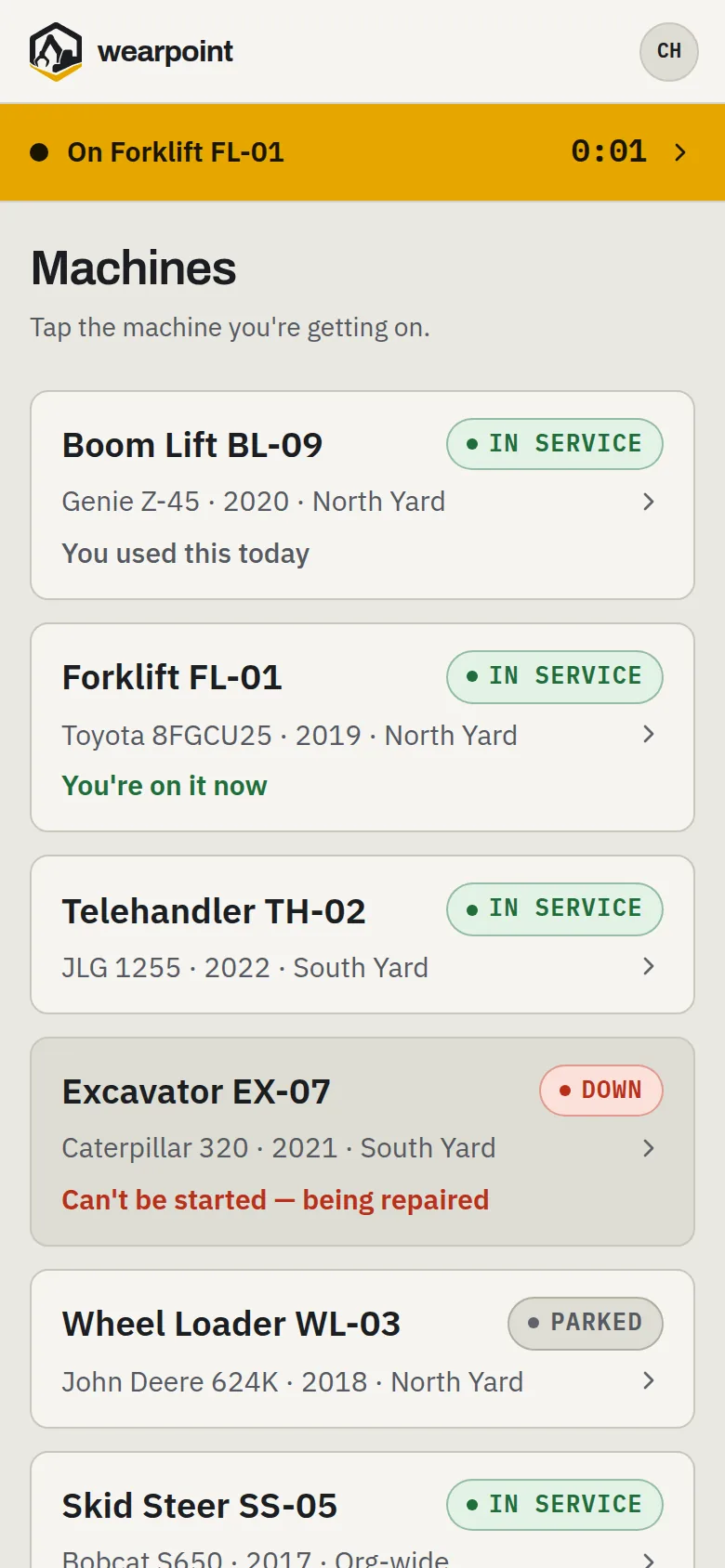
You build the checklist once in wearpoint as an inspection template for your scissor lifts, in your own words and the order your crew walks them, and every scissor lift uses it. Every item takes a verdict — OK, Issue, or N/A. A defect is flagged with a quick note, and open defects carry forward to the next inspection until the fix is recorded. The operator raises a defect as an issue in one tap, the shop triages it into a work order, and the people responsible get an alert when a machine goes down. A machine marked down can’t be started from the app until it’s repaired, so the lift with the dead tilt alarm stays parked.
Operators tap in on the machine and enter the hour-meter reading when they tap out, so service comes due on the hours each lift actually ran. Two operators on one lift in a day means two inspections and two records. If you run booms too, the boom lift checklist covers the turntable, the jib, and the harness.