Telehandler pre-use inspection checklist
A telehandler looks like a forklift with ambitions, and it gets checked like one for the basics: tires, fluids, brakes, horn. What the forklift checklist doesn’t cover is the reach. A boom that telescopes out over a slab edge, an attachment swapped several times a shift, steering that can be left in crab mode, and a stability system that only protects you if it works — those are the checks that keep the machine on its wheels.
Walk it in this order with the boom retracted and the attachment on the ground. Your operator’s manual is the authority for anything specific to your model: the fluid marks, the stability system test, the wind limit. The table after the checklist sets out what each province and US OSHA asks, rule by rule.
Engine off — the walkaround
Boom fully retracted and lowered, attachment on the ground, park brake on, key in your pocket.
- Boom sections and wear pads — sections straight, no dents or cracked welds; wear pads present and not worn to the backing; no fresh metal shavings at the boom nose.
- Boom pins and retainers — every pin in its bore with its retaining bolt or clip fitted; a pin walking out shows as a bright ring.
- Frame and welds — cracks at the boom pivot, axle mounts, and frame welds; a line of flaking paint is often a crack underneath.
- Carriage and attachment — forks straight and uncracked, heels not worn thin; the attachment’s locking pin fully through and retained.
- Load chart for this attachment — the chart for the attachment actually fitted is in the cab and legible; decals and warnings readable.
- Outriggers and pads, if fitted — pads present and swivelling, cylinders dry, no bent legs; the outriggers retract fully for travel.
- Tires and wheel nuts — cuts, bulges, and pressure; every wheel nut there and tight, no rust streaks running from one.
- Hoses and cylinders — wet fittings, chafed covers, scored or pitted rods. Look for leaks and never run a hand along a hose to feel for one.
- Fluids — engine oil, hydraulic oil, coolant, and fuel at the marks your operator’s manual shows; diesel exhaust fluid where fitted.
- Cab, steps, and handholds — glass, mirrors, and wipers; steps clear of mud and ice, handholds tight; nothing loose rolling under the pedals.
- ROPS/FOPS and seat belt — no cracks, bends, or holes drilled into the cab structure; the belt latches, retracts, and isn’t frayed.
Engine on — the function checks
- Boom functions and drift — lift, telescope, tilt, and auxiliary through full travel, smooth; nothing creeps with the controls released.
- Frame level, if fitted — the frame levels both ways and holds; the level indicator agrees with what you see.
- Steering modes — front-wheel, four-wheel, and crab each respond; wheels aligned and the machine set back to the mode you travel in.
- Service and park brakes — the machine stops square and holds on the park brake.
- Stability system test — run the load-moment indicator or stability system test your manual describes; the display and alarms come on and clear.
- Lights, beacon, horn, and alarm — work lights, beacon, horn, and backup alarm all working.
- Gauges and warning lights — nothing lit that shouldn’t be; hour meter reading noted.
Around the machine
- Ground firmness and slope — firm, level enough for the lift you’re planning; watch backfilled trenches, soft shoulders, and frozen ground thawing.
- Overhead lines — where every line is relative to the full reach of the boom, not just where the machine sits.
- Nobody under the load — where people will be while you lift and place, and how you’ll keep them out from under the boom.
- Wind for high placements — gusts at the top of the reach, not just at the ground; your manual sets the limit.
 wearpoint
What the rules ask, jurisdiction by jurisdiction
Do this walkaround before every shift. Where a rule below doesn’t name a daily inspection, it often requires the machine to be inspected or used according to the manufacturer’s instructions — so check what your operator’s manual calls for before each shift.
Each row is what one regulation asks of this machine, in plain words, with a link to the text. Where a rule depends on the kind of site or machine, the row says so: check it against your own. This is a summary, not legal advice — the regulation and your operator’s manual govern.
Alberta
Before operating powered mobile equipment, the operator must complete a visual inspection of the equipment and the surrounding area. OHS Code s.257(1)
British Columbia
Before mobile equipment is first operated on a shift, the operator must inspect it and report any unsafe or potentially unsafe defect to the supervisor or employer, then keep monitoring it while it runs. The employer keeps a record of reported defects for at least 2 years. OHSR 16.3(1)–(3)
The design, fabrication, use, inspection, maintenance, and repair of a forklift must meet CSA B335-15 or, as applicable, ANSI/ITSDF B56.1a-2018, ANSI/ITSDF B56.6-2016 for rough-terrain forklifts, or ISO 10896 for variable-reach and slewing rough-terrain machines — or the earlier version of the standard that applied when it was built. OHSR 16.43(1)
If your telehandler is a variable-reach rough-terrain machine as ANSI/ITSDF B56.6 defines it, it also needs an inspection and maintenance log meeting s.4.9, which includes an entry each shift, signed by the operator, reporting the start-of-shift inspection. OHSR 16.43(4), 4.9(2)
Ontario
Construction projects: No vehicle or machine may be used while it is defective or hazardous, and it must be used as its manufacturer’s operating manual says. Powered equipment rated over 10 horsepower must be inspected by a competent worker before it is first used at the project, then at least once a year or more often if the manufacturer recommends. Neither section sets a daily inspection. O. Reg. 213/91 ss.93–94
Industrial establishments: A lifting device — a device used to raise or lower material — must be thoroughly examined by a competent person for its rated load before it is first used, then as often as needed but no less often than the manufacturer recommends and at least once a year, with a signed record. Reg. 851 s.51(1)(b)
Every workplace: The employer must keep the equipment it provides in good condition, and a worker must report a known defect that may endanger a worker to the employer or supervisor. OHSA ss.25(1)(b), 28(1)(c)
Quebec
Construction sites: The operator must give a hoisting apparatus a visual inspection and an operational test, as the manufacturer instructs, each day it is used. The Code’s definitions give as examples forklifts (platform or fork), self-propelled articulating or telescopic boom platforms, and self-propelled scissor platforms; any other apparatus designed to lift materials or people counts too. CSTC ss.1.1, 2.15.1(1)(e)
Elsewhere, such as a yard or plant: A lifting apparatus — the definition includes forklifts and elevating platforms — must be checked before its first use, then inspected and maintained according to the manufacturer’s instructions or standards offering equivalent safety. RSST ss.1, 245
Nova Scotia
The employer must ensure powered mobile equipment and forklifts are operated, inspected, serviced, maintained, and repaired according to the manufacturer’s specifications, or specifications certified by an engineer. N.S. Reg. 44/99 s.55
The employer must ensure a forklift is designed, constructed, maintained, inspected, and operated to the latest version of the applicable standard: CSA B335, ANSI/ITSDF B56.1, or ANSI/ITSDF B56.6 for rough-terrain forklifts. N.S. Reg. 44/99 s.81(1)
United States (federal OSHA)
General industry: If your telehandler counts as a powered industrial truck — OSHA’s forklift guidance lists the variable-reach rough-terrain forklift as Class VII — it must be examined before it is placed in service, at least daily. 29 CFR 1910.178(q)(7)
Construction sites: The employer’s safety program must provide for frequent and regular inspections of equipment by competent persons it designates. Equipment that doesn’t comply with OSHA’s construction rules may not be used and must be tagged, have its controls locked, or be removed. 29 CFR 1926.20(b)(2)–(3)
Construction sites: A telehandler configured with a winch or hook to hoist, lower, and horizontally move a suspended load falls under OSHA’s crane rules, where a competent person must begin a visual inspection before each shift the equipment will be used, and complete it before or during that shift. 29 CFR 1926.1400(a), (c)(8), 1926.1412(d)(1)
Not in the table yet: Saskatchewan, Manitoba, New Brunswick, Prince Edward Island and Newfoundland and Labrador. We add a province once its official text has been checked.
The load chart and the attachment
A telehandler doesn’t have one capacity. What it can safely hold depends on how high the boom is raised, how far it’s extended, and what’s on the end of it. The same pallet that rides comfortably close in can tip the machine forward at full reach. That is why there is a load chart in the cab, and why there is usually more than one: each approved attachment — forks, a bucket, a truss jib, a work platform — has its own.
So the check is not just “Is the chart there?” It is “Is the chart for the attachment I’m running there, and can I read it?” When the attachment changes mid-shift, the chart you use changes with it, and the locking pin gets checked again. If the attachment has no chart for this machine, it doesn’t go on this machine. Read the chart for the lift before you make it, not after the load is in the air.
Lifting people or hanging loads
People go up on a telehandler only in a work platform the machine’s manufacturer approves for it, used with that platform’s own chart and set up the way the manual describes. Never a pallet on the forks, never a bucket, never anyone riding the carriage. If the platform has its own controls or a switch that limits the machine’s functions, test them on the ground before anyone climbs in.
Hanging loads work the same way: a manufacturer-approved jib or hook attachment, its chart, and rigging that has been inspected. A suspended load swings, and a swinging load at reach changes the numbers the chart gave you. Use tag lines, travel slowly with the load low, and keep everyone clear of the swing.
When something fails
Take the machine out of service. Tag it where the next operator will see it, take the key, and tell your supervisor. Only a qualified mechanic repairs it: a stability alarm that won’t clear or a boom that drifts is not something to work around for the rest of the shift. The defect that gets noted and left running is the one that hurts someone.
How wearpoint runs this checklist
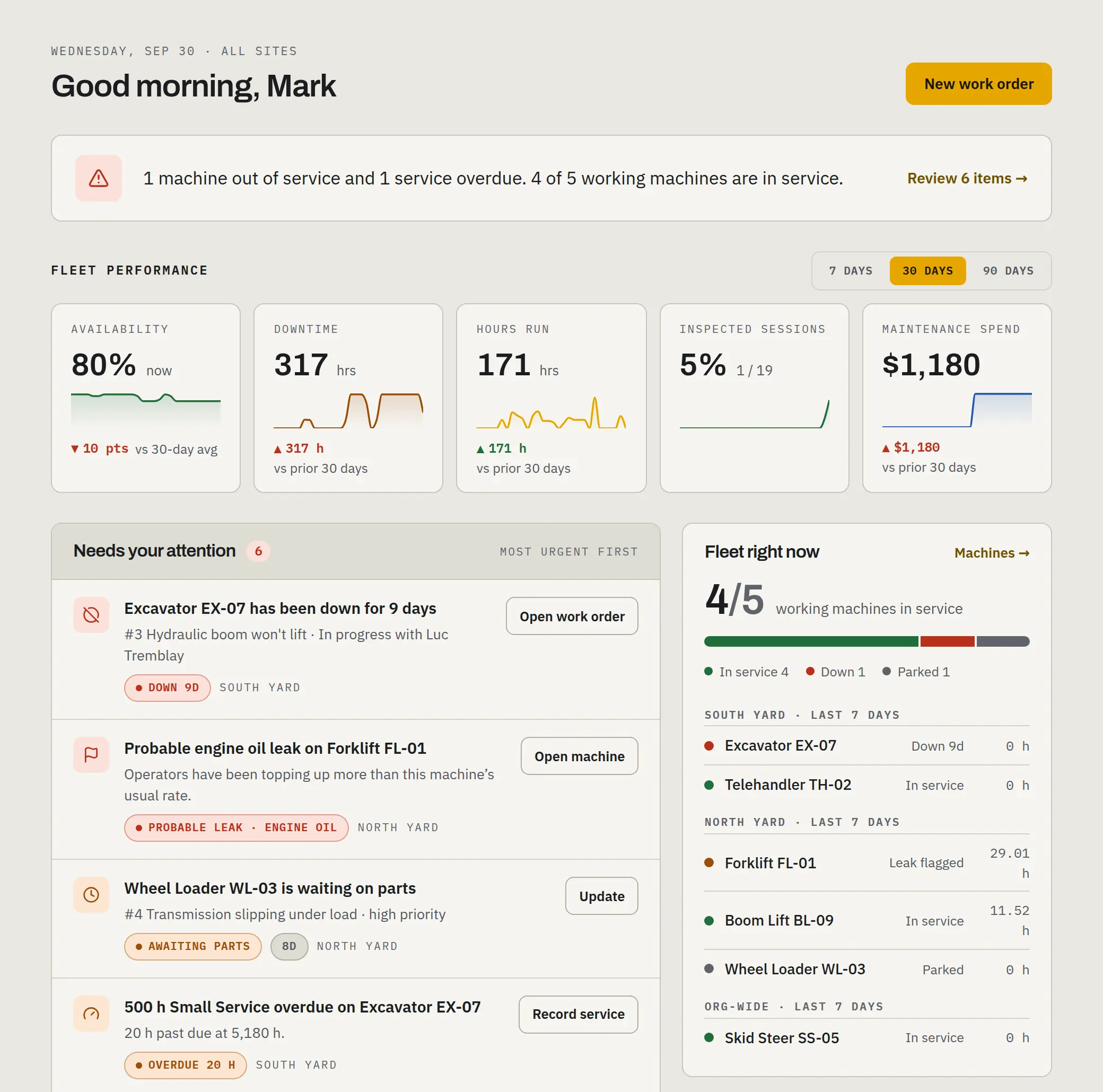
You build the checklist once in wearpoint as an inspection template for your telehandlers, in your own words and the order your crew walks the machine, and every telehandler uses it. Every item takes a verdict — OK, Issue, or N/A. A defect is flagged with a quick note, and open defects carry forward to the next inspection until the fix is recorded. The operator raises a defect as an issue in one tap, the shop triages it into a work order, and the people responsible get an alert when a machine goes down; a machine marked down can’t be started from the app until it’s repaired.
Operators tap in on the machine and enter the hour-meter reading when they tap out, so service comes due on the hours it actually ran. Add a top-up line for hydraulic oil and the litres get logged; when a machine’s weekly top-ups run at three times its own 30-day norm, wearpoint flags a probable leak. It tells you which telehandler to look at, not which hose. And when an operator takes over mid-shift, they run their own inspection: two inspections, two records. See how it fits the machines a construction outfit runs.