Forklift daily inspection checklist
A forklift gets examined before it goes to work, every day it works. Here is the walkaround in the order you’d actually walk it: key off, then the power source — battery or propane — then key on, then the ground you’ll drive. Your operator’s manual lists the items particular to your model, and it is the authority wherever the two differ.
The table after the checklist sets out what each province and US OSHA asks, rule by rule.
Key off — the walkaround
- Tires, wheels, and lugs — cuts, chunking, pressure (or splits in solid tires), missing wheel nuts. Debris eats tires; this is where it shows first.
- Forks — cracks anywhere, bent or unevenly worn blades, heel wear past the wear line, the positioning latch seating properly.
- Carriage, backrest, and finger guards — secure, straight, no cracked welds; finger guards in place where the mast has them.
- Mast, lift chains, and rollers — chain tension even side to side, no kinked or rusted links, no debris in the channels. Judge it by eye or with a tool — never reach into the mast.
- Hydraulics — hoses and cylinders dry; look for weeping at fittings, never feel for it. Then look under the machine: a fresh puddle is a failed check.
- Fluids — engine oil, hydraulic oil, coolant, and brake fluid where the machine has a reservoir; fuel level on engine-powered forklifts.
- Overhead guard and seat belt — guard undamaged and tight; belt present, latching, and not chewed up.
- Data plate, decals, and manual — plate legible and matching any attachment fitted — the capacity you’re trusting is the one on the plate; warning decals in place; the operator’s manual on board.
- Operator compartment — floor, pedals, and steps free of grease, debris, and loose tools.
The power source — electric or propane
Check the one your forklift runs on and mark the other N/A.
- Battery cables and connectors — no fraying, cuts, or exposed wire; connector seated; battery restrained; hood or seat latch closing.
- Battery electrolyte and terminals — electrolyte level checked with eye protection and gloves on batteries that need it; terminals clean, no corrosion.
- Propane tank mounting — tank seated in its bracket, locating pin engaged, straps tight, relief valve pointing the way the manual shows.
- Propane hose and fittings — no cuts, cracks, or frost on the hose, no smell of gas. Check a suspected leak with soapy water, never a flame.
Key on — the function checks
- Horn and backup alarm — both, every time. In a yard with mobile shears and grapple excavators working, the horn is the machine’s only voice.
- Lights and beacons — head, tail, and warning lights working.
- Accelerator and inching pedal — smooth, and both return on their own; the inching pedal slows the forklift without killing the lift.
- Forward and reverse — the direction control selects cleanly and the forklift moves the way you chose.
- Service brakes and parking brake — the forklift stops where you asked and stays where you left it, loaded.
- Steering — no excessive play, no groaning at full lock.
- Lift, tilt, side-shift, and attachments — full travel, smooth, no drift with the controls released; any attachment through every function.
- Gauges and warning lights — nothing lit that shouldn’t be; hour meter reading noted.
- Listen — new noises are the machine filing its own report.
Around the machine
- Ground and route — drop-offs, holes, soft spots, and obstructions on the way you’ll drive and where you’ll set loads down.
- People and traffic — where people on foot and other machines cross your path, and how you’ll see them coming.
 wearpoint
What the rules ask, jurisdiction by jurisdiction
Do this walkaround before every shift. Where a rule below doesn’t name a daily inspection, it often requires the machine to be inspected or used according to the manufacturer’s instructions — so check what your operator’s manual calls for before each shift.
Each row is what one regulation asks of this machine, in plain words, with a link to the text. Where a rule depends on the kind of site or machine, the row says so: check it against your own. This is a summary, not legal advice — the regulation and your operator’s manual govern.
Alberta
Before operating powered mobile equipment, the operator must complete a visual inspection of the equipment and the surrounding area. OHS Code s.257(1)
British Columbia
Before mobile equipment is first operated on a shift, the operator must inspect it and report any unsafe or potentially unsafe defect to the supervisor or employer, then keep monitoring it while it runs. The employer keeps a record of reported defects for at least 2 years. OHSR 16.3(1)–(3)
The design, fabrication, use, inspection, maintenance, and repair of a forklift must meet CSA B335-15 or, as applicable, ANSI/ITSDF B56.1a-2018, ANSI/ITSDF B56.6-2016 for rough-terrain forklifts, or ISO 10896 for variable-reach and slewing rough-terrain machines — or the earlier version of the standard that applied when it was built. OHSR 16.43(1)
Ontario
Construction projects: No vehicle or machine may be used while it is defective or hazardous, and it must be used as its manufacturer’s operating manual says. Powered equipment rated over 10 horsepower must be inspected by a competent worker before it is first used at the project, then at least once a year or more often if the manufacturer recommends. Neither section sets a daily inspection. O. Reg. 213/91 ss.93–94
Industrial establishments: A lifting device — a device used to raise or lower material — must be thoroughly examined by a competent person for its rated load before it is first used, then as often as needed but no less often than the manufacturer recommends and at least once a year, with a signed record. Reg. 851 s.51(1)(b)
Every workplace: The employer must keep the equipment it provides in good condition, and a worker must report a known defect that may endanger a worker to the employer or supervisor. OHSA ss.25(1)(b), 28(1)(c)
Quebec
Construction sites: The operator must give a hoisting apparatus a visual inspection and an operational test, as the manufacturer instructs, each day it is used. The Code’s definitions give as examples forklifts (platform or fork), self-propelled articulating or telescopic boom platforms, and self-propelled scissor platforms; any other apparatus designed to lift materials or people counts too. CSTC ss.1.1, 2.15.1(1)(e)
Elsewhere, such as a yard or plant: A lifting apparatus — the definition includes forklifts and elevating platforms — must be checked before its first use, then inspected and maintained according to the manufacturer’s instructions or standards offering equivalent safety. RSST ss.1, 245
Nova Scotia
The employer must ensure powered mobile equipment and forklifts are operated, inspected, serviced, maintained, and repaired according to the manufacturer’s specifications, or specifications certified by an engineer. N.S. Reg. 44/99 s.55
The employer must ensure a forklift is designed, constructed, maintained, inspected, and operated to the latest version of the applicable standard: CSA B335, ANSI/ITSDF B56.1, or ANSI/ITSDF B56.6 for rough-terrain forklifts. N.S. Reg. 44/99 s.81(1)
United States (federal OSHA)
General industry: A forklift must be examined before it is placed in service, at least daily, and after each shift where it runs around the clock. Defects must be reported and corrected immediately, and a forklift found defective or in any way unsafe is taken out of service until it is restored. 29 CFR 1910.178(p)(1), (q)(7)
Construction sites: A forklift in use must meet the applicable inspection, maintenance, and operation requirements of ANSI B56.1-1969, which OSHA’s construction rules incorporate. 29 CFR 1926.602(c)(1)(vi)
Construction sites: The employer’s safety program must provide for frequent and regular inspections of equipment by competent persons it designates. Equipment that doesn’t comply with OSHA’s construction rules may not be used and must be tagged, have its controls locked, or be removed. 29 CFR 1926.20(b)(2)–(3)
Not in the table yet: Saskatchewan, Manitoba, New Brunswick, Prince Edward Island and Newfoundland and Labrador. We add a province once its official text has been checked.
Look, don’t reach
Two of these checks hurt people who do them the wrong way. Chain tension and the mast are judged by eye, or with a tool against the chain, with the forks down and the key out — never with a hand inside the mast, where a drifting carriage or a bumped lever closes the gap. And a hydraulic leak is found by looking: a pinhole leak at working pressure can push oil through skin, so nobody runs a hand along a hose to find the wet spot.
When something fails
The regulation is blunt: a defective forklift is taken out of service until it’s fixed. Practically, that means the forks go down, the key comes out, and the forklift is tagged out where the next operator will see it. Report the defect to your supervisor the same shift, and leave the repair to someone authorized to make it. Then the defect gets recorded, and the repair becomes a job somebody owns — not a note on a whiteboard.
Keep an inspection record
Paragraph (q)(7) requires the examination and says nothing about writing it down, though BC’s 16.3 requires a record of any defect reported, kept for two years. Either way, your insurer’s loss-control auditor, an incident investigator, and your own memory all want one. A signed-off, timestamped checklist with a verdict on every item is the difference between “we inspect daily” and being able to show it.
How wearpoint runs this checklist
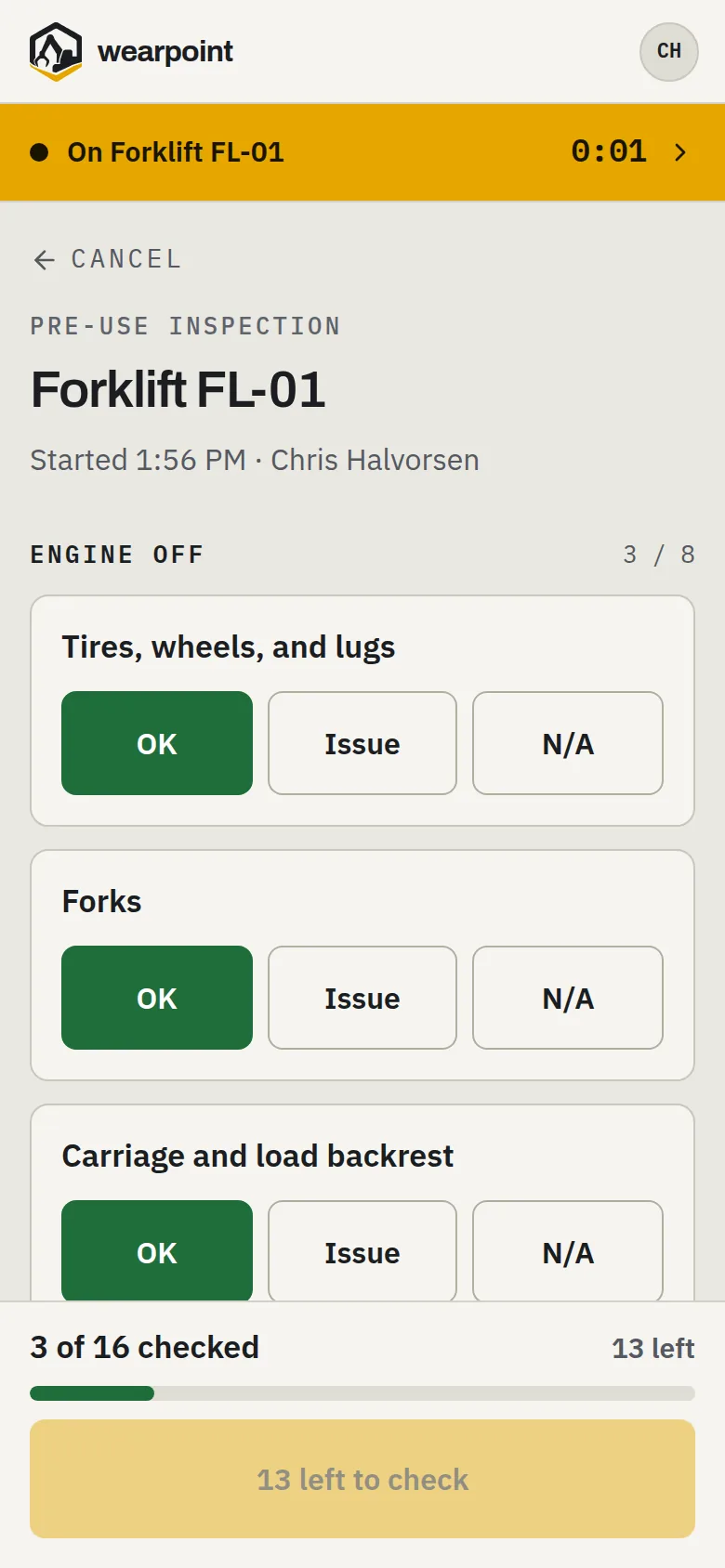
You build the forklift checklist in wearpoint once, as an inspection template: the checks above, in your own words and the order your crew walks them, and every forklift uses it. Every item takes a verdict — OK, Issue, or N/A, which is how an electric forklift answers the propane lines. A defect is flagged with a quick note, and open defects carry forward to the next inspection until the fix is recorded. The operator raises a defect as an issue in one tap, the shop triages it into a work order, and the right people get an alert when a machine goes down. The record keeps itself.