Roller and compactor daily inspection checklist
A roller looks like the simplest machine on the job: it goes forward, it goes back, it shakes. The daily check is for the parts that take the shaking all shift — the drums, the scraper bars, the rubber isolator mounts, the articulation — and for the few things that keep the operator alive when the ground at the edge gives way. On an asphalt roller it also covers the spray system, because a dry nozzle shows up in the mat before it shows up anywhere else.
This list covers ride-on rollers: single-drum soil compactors (smooth or padfoot), tandem asphalt rollers, and pneumatic-tire rollers. Walk-behind plate compactors and rammers need their own shorter list, built from their operator’s manual. For every machine, the manual is the authority on model-specific items, settings, and limits. The table after the checklist sets out what each province and US OSHA asks, rule by rule.
Engine off — the walkaround
- Drums — shell free of cracks, gouges, and built-up material; on padfoot drums, no broken, worn-down, or missing pads.
- Scraper bars — present, straight, and set to the drum as your manual describes; a loose scraper drags, a bent one gouges.
- Vibration isolator mounts — the rubber mounts between drum and frame: no cracks, tears, rubber parting from the plate, or missing bolts.
- Articulation joint and lock — pins greased, no play or cracked welds; the lock stowed for work and fitted only for transport or service.
- Tires — on pneumatic rollers, cuts, bulges, and even pressure on every tire; on single-drum machines, the drive tires too.
- Water spray system — on asphalt rollers: tanks filled, filters clean, nozzles clear, and lines drained or protected if it froze overnight.
- Hoses — drive and vibration hoses dry and not chafed at the articulation; look for leaks, never feel for them by hand.
- Fluids — engine oil, hydraulic oil, coolant, and fuel at their marks, and no fresh drips on the ground under the drums.
- ROPS and seat belt — ROPS bolts tight, no cracks or bends; belt present, latching, retracting, and not frayed.
- Steps, cab or canopy, mirrors — steps and handholds solid and clear of mud and mix; glass or canopy intact; mirrors there and set.
Engine on — the function checks
- Travel lever and neutral start — starts only in neutral; forward and reverse smooth; the roller stops in neutral without creeping.
- Service and park brakes — the roller stops where you ask and holds on a grade with the park brake set.
- Emergency stop — press it, confirm it shuts the machine down, and reset it the way your manual shows.
- Steering — full lock both ways through the articulation, no binding, lag, or wander.
- Vibration and amplitude selector — vibration switches on and off cleanly, each amplitude setting engages, and no new knocking from the drum.
- Spray on — on asphalt rollers, every nozzle wets the full width of the drum or tires.
- Travel alarm, horn, lights, beacon — alarm sounds in both directions where fitted; horn, work lights, and beacon all working.
- Gauges and warning lights — nothing lit that shouldn’t be; hour meter reading noted.
Around the machine
- Edges, slopes, and shoulders — trench edges, embankments, fresh fill, and soft shoulders on today’s passes: that is where rollers tip.
- Crews on foot — where the rakers, screed crew, and grade checker will stand, and how you’ll see them when you reverse.
- Other machines — the paver, other rollers, and anything else sharing the lane, and who signals whom.
 wearpoint
What the rules ask, jurisdiction by jurisdiction
Do this walkaround before every shift. Where a rule below doesn’t name a daily inspection, it often requires the machine to be inspected or used according to the manufacturer’s instructions — so check what your operator’s manual calls for before each shift.
Each row is what one regulation asks of this machine, in plain words, with a link to the text. Where a rule depends on the kind of site or machine, the row says so: check it against your own. This is a summary, not legal advice — the regulation and your operator’s manual govern.
Alberta
Before operating powered mobile equipment, the operator must complete a visual inspection of the equipment and the surrounding area. OHS Code s.257(1)
British Columbia
Before mobile equipment is first operated on a shift, the operator must inspect it and report any unsafe or potentially unsafe defect to the supervisor or employer, then keep monitoring it while it runs. The employer keeps a record of reported defects for at least 2 years. OHSR 16.3(1)–(3)
Ontario
Construction projects: No vehicle or machine may be used while it is defective or hazardous, and it must be used as its manufacturer’s operating manual says. Powered equipment rated over 10 horsepower must be inspected by a competent worker before it is first used at the project, then at least once a year or more often if the manufacturer recommends. Neither section sets a daily inspection. O. Reg. 213/91 ss.93–94
Every workplace: The employer must keep the equipment it provides in good condition, and a worker must report a known defect that may endanger a worker to the employer or supervisor. OHSA ss.25(1)(b), 28(1)(c)
Quebec
Construction sites: Any self-propelled vehicle or equipment driven by a power source other than manual must be checked by an experienced person before its first use on the site, then daily whenever it is used. CSTC s.3.10.1(b)
Elsewhere, such as a yard or plant: A self-propelled vehicle must be inspected and maintained according to the manufacturer’s instructions or standards offering equivalent safety. Section 272 sets no inspection frequency of its own. RSST s.272
Nova Scotia
The employer must ensure powered mobile equipment and forklifts are operated, inspected, serviced, maintained, and repaired according to the manufacturer’s specifications, or specifications certified by an engineer. N.S. Reg. 44/99 s.55
United States (federal OSHA)
Construction sites: OSHA’s earthmoving equipment rules set no inspection interval of their own. 29 CFR 1926.602(a)
Construction sites: The employer’s safety program must provide for frequent and regular inspections of equipment by competent persons it designates. Equipment that doesn’t comply with OSHA’s construction rules may not be used and must be tagged, have its controls locked, or be removed. 29 CFR 1926.20(b)(2)–(3)
Not in the table yet: Saskatchewan, Manitoba, New Brunswick, Prince Edward Island and Newfoundland and Labrador. We add a province once its official text has been checked.
Edges and slopes: why the seat belt matters most on a roller
A roller spends its day at the edge on purpose: the shoulder, the trench backfill, the last pass along the mat. The ground right at the edge is the loosest on the site. Fresh fill slumps, a soft shoulder lets go, a trench wall sloughs under the drum. A single-drum compactor carries its weight high and forward, and vibration can unsettle an edge that held a minute ago.
When a roller starts to go over, the instinct is to jump. That instinct is the one that kills: the operator lands where the machine lands. The ROPS protects only the space inside it, and the seat belt is what keeps you there. Belt on for every pass, however short. Stay back from edges as far as your manual says, compact from the solid side, keep within the machine’s slope limits, and if the ground starts to move, hold on and stay in the seat.
Asphalt and soil machines: what differs
On a tandem or pneumatic asphalt roller, the spray system is the daily worry. Water, or the release agent your manual allows, keeps hot mix off the drums and tires; a clogged filter or dead nozzle lets mix pick up on the drum and tear the surface on the next pass. Tank grit is what clogs them, so clean the filters before they starve the pump. In cold weather, drain or protect the system the way the manual describes before the machine sits overnight. On a pneumatic roller, uneven tire pressure means uneven compaction.
A padfoot compactor has no spray to worry about, but it has clay. Wet clay packs between the pads and behind the scraper bars, then sets hard enough to bend a scraper or hide a broken pad. Clean it out before it dries, and only with the engine off, the drum stopped, and the articulation lock fitted if you are working near the joint. Never reach between a drum and a scraper, or into the articulation, on a machine that can move.
When something fails
A roller that fails its check comes out of service. Tag it where the next operator will see it, take the key, and report it to your supervisor. Only a qualified mechanic repairs it. A defect that gets written down and then run anyway — a torn isolator mount, a dragging brake, a seat belt that won’t latch — is the one that ends up hurting someone.
How wearpoint runs this checklist
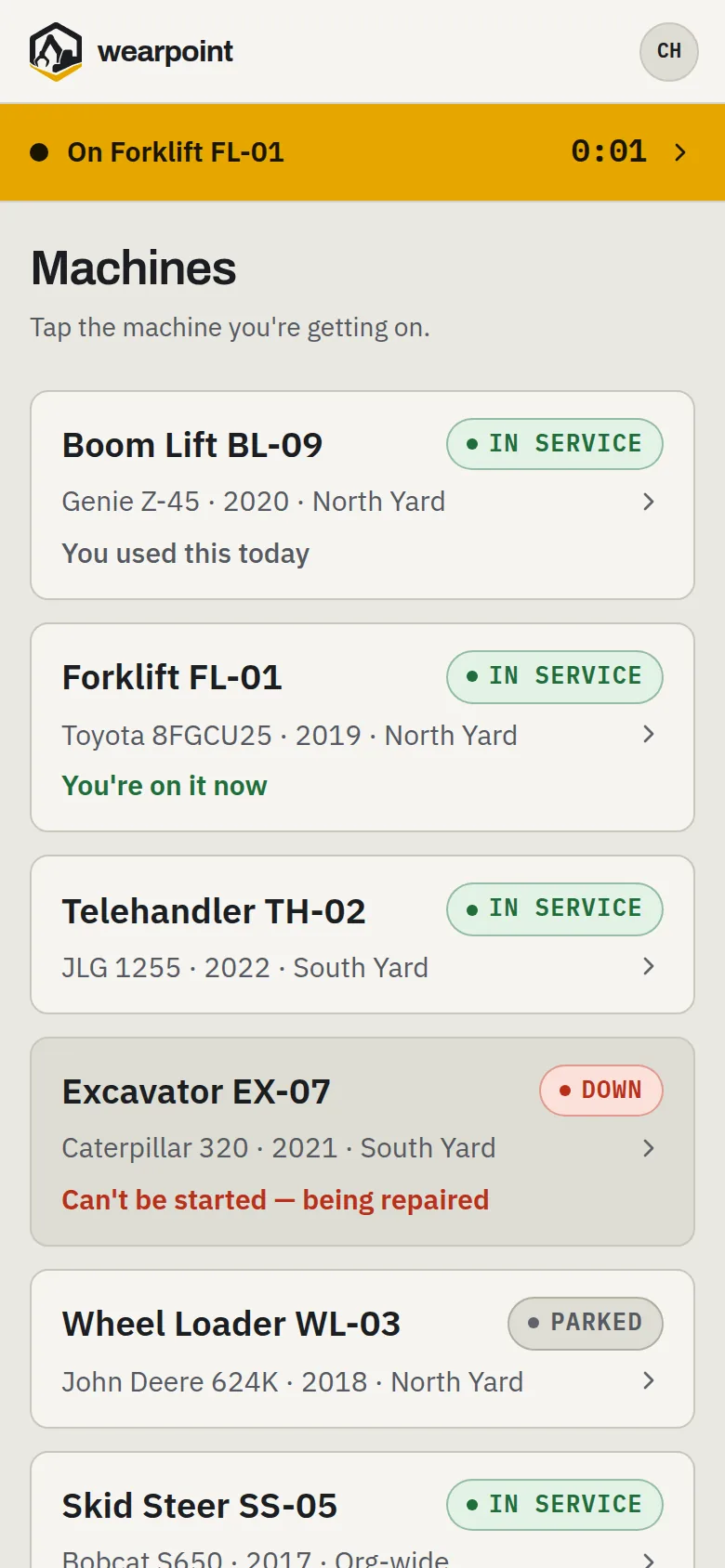
You build the roller checklist in wearpoint once, as an inspection template for the category, in your own words and walk order, and every roller uses it. Every item takes a verdict — OK, Issue, or N/A — so a padfoot compactor marks the spray items N/A and moves on. A defect is flagged with a quick note, and open defects carry forward to the next inspection until the fix is recorded. The operator raises a defect as an issue in one tap, the shop triages it into a work order, the people responsible get an alert when a machine goes down, and a roller marked down can’t be started from the app until it’s repaired.
Operators tap in on the machine and enter the hour-meter reading when they tap out, so service comes due on the hours the roller actually ran. Add a top-up line for hydraulic oil and wearpoint logs the litres added; when one machine’s top-ups over a week run at three times its own 30-day norm, it flags a probable leak. It tells you which roller to look at, not which hose. See how it fits the machines a construction outfit runs.